IPTV Providers: How to Tell a Reliable One From the Rest
IPTV providers look identical on a sales page. They differ in what happens after you pay. This guide shows how to tell them apart beforehand: by type, by website, by first contact and by a short list of questions.
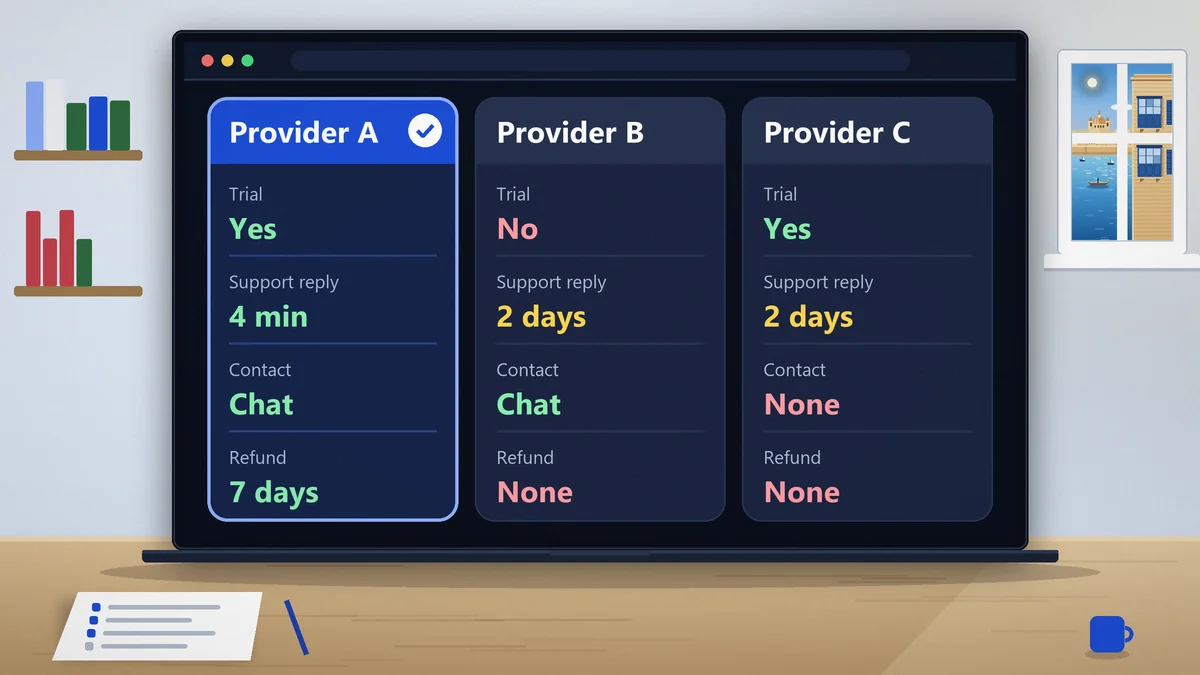
Choosing among IPTV providers is less about television than about trust. The channels can be checked in an evening. The harder question is who you are dealing with: whether they will answer in three months, whether the price will stay what it was, whether a problem will be fixed or explained away.
Most of that can be read before any money changes hands. A provider reveals itself in its website, in its first reply and in how it reacts to five simple questions. This guide sets out what to look at, in the order in which you meet it.
Testing the picture itself is a separate job, covered in the guide to the best IPTV. You can apply everything below to us as well: start with the contact page or a free trial.
Reply in English within minutes, 24 hours a day.
In euros, complete, with no contract.
What an IPTV provider is
An IPTV provider is the company or the person who sells you access to television over the internet and stands behind it afterwards. The second half of that sentence is the important one. Anyone can hand over login details. A provider is the party you can go back to.
In practice a provider takes on four responsibilities:
- Opening the account: creating your line and helping you install it.
- Keeping it working: stable streams, a maintained channel list, a TV guide.
- Answering: being reachable when something goes wrong.
- Being clear about money: prices, renewal and refunds in writing.
A seller who covers the first and none of the other three is a source of logins, not a provider. The rest of this guide is about telling the two apart.
The four kinds of IPTV providers
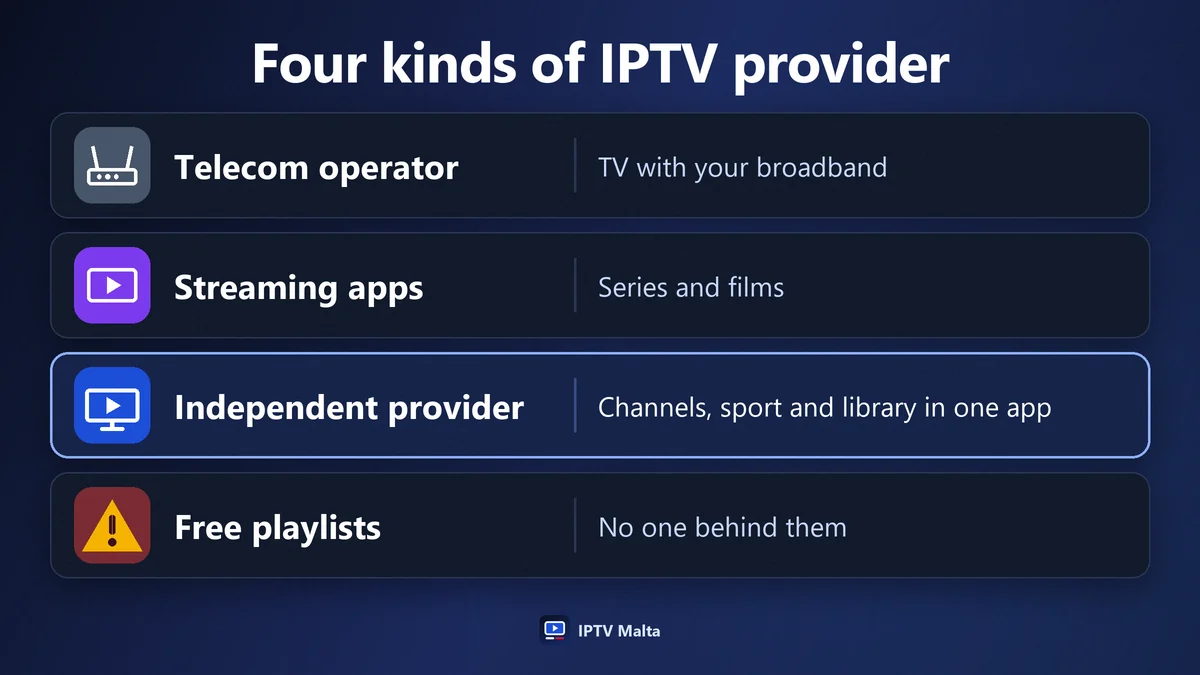
The word covers very different things. Knowing which kind you are looking at explains most of what follows.
| Kind | What you get | Contract | Support |
|---|---|---|---|
| Telecom operator | TV bundled with home broadband | Usually 12 to 24 months | Call centre |
| Streaming apps | Series and films, little live TV | Monthly, per app | Help pages |
| Independent provider | Channels, sport and a library in one app | None, fixed period | Direct chat |
| Free playlists | Unsorted links | None | None |
Telecom operators
Reliable and local, with a box and an engineer. The price of that comfort is a contract tied to your address and sports or movie packs sold one by one.
Streaming apps
Excellent catalogues, easy to cancel, and almost no live channels. They complement television rather than replace it.
Independent providers
They sell access to a large channel list and a library for a fixed period, on your own devices. Quality varies enormously from one to the next, which is why the checks in this guide exist. We belong to this group.
Free playlists
Not providers at all: nobody is responsible for anything. They are listed here because they are what most searches turn up first.
Who is actually behind an independent provider
Independent providers do not all do the same job. Some operate close to the service itself. Many are resellers: they buy access in volume and sell it on, handling the customers themselves.
A reseller is not a bad sign. A good one adds real value: a local language, quick answers, help with installation. What matters is whether the person in front of you can get a problem fixed. A seller three steps away from anyone technical can only forward your message and wait.
You find out with one question: “If a channel goes down tonight, who fixes it, and how long does it usually take?” A provider who knows the answer gives it without hesitating.
What a provider’s website tells you
Five minutes on a site reveal more than its claims do. Look for what is there, and for what is missing.
Prices in plain view
A full price list, in your currency, by length and number of screens. “Contact us for prices” on a consumer product is a reason to leave.
A way to reach someone
A chat number, an email address, opening hours. A site with only an order button has decided not to hear from you afterwards.
Legal pages
Terms of service, a privacy policy and a refund policy that say something specific: a number of days, the conditions, how to ask. Vague or missing pages mean the provider has not committed to anything.
Installation help
Instructions for real devices, step by step. A provider who has explained how to install on a Fire TV Stick has clearly done it for customers before.
Claims you can check
A trial is a claim you can check. “Zero buffering, guaranteed forever” is not. Prefer the provider who offers the first to the one who promises the second.
The first conversation with a provider
Write before you buy. The reply is a free sample of the support you will receive for the length of your subscription.
- How long did it take? Minutes is good, hours is a warning, a day is an answer in itself.
- Did it answer the question? Or did it paste a price list and a payment link?
- Was it written by a person? Someone who read your message refers to what you said.
- Did it push? “Offer ends in ten minutes” is pressure, not service.
Write a second time in the evening or at the weekend. A provider who answers at 15:00 on a Tuesday and not at 21:00 on a Saturday is not there when television is on.
Seven questions to ask IPTV providers before paying
Copy them into a message. A reliable provider answers all seven without discomfort.
- Is there a trial, and what does it include? Full access, or a reduced list?
- Does it work on my device? Name the model: Smart TV, stick, box.
- How many screens can play at once? And what happens if I open one more?
- Does the subscription renew by itself? It should not.
- What is the refund policy? How many days, under what conditions?
- What do I do if a channel stops working? Who do I write to, and when?
- Is the price complete? Any activation fee, any supplement?
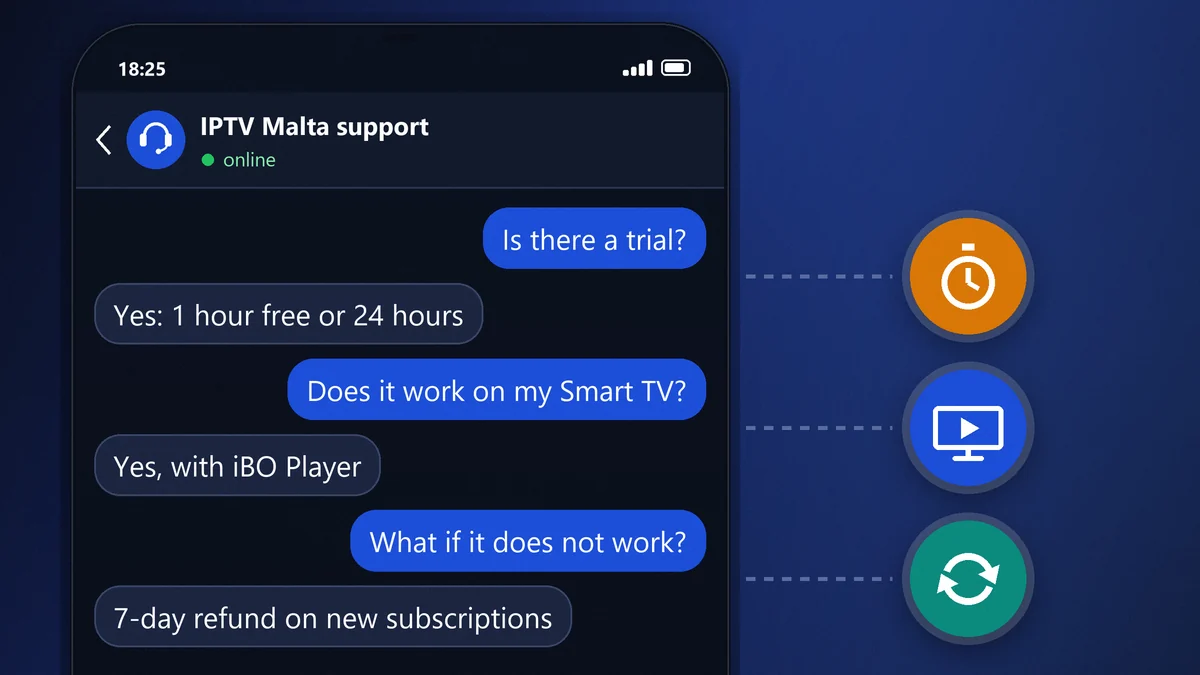
Our own answers: 1 hour free or 24 hours for €2.95 with full access; every common device; 1, 2 or 3 screens depending on the plan; no automatic renewal; 7 days on a new subscription; WhatsApp, 24 hours a day; and no fee beyond the price shown.
Answers in English, usually within minutes.
Good signs and red flags
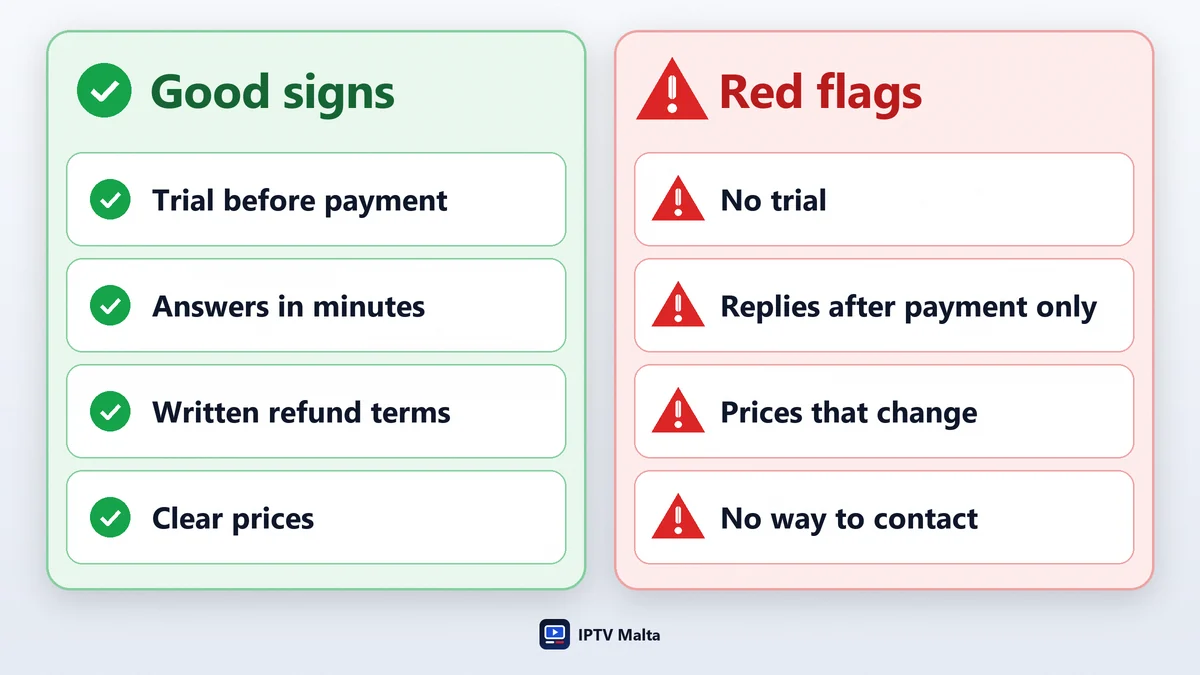
Put side by side, the difference between two kinds of provider is easy to see.
| Topic | Good sign | Red flag |
|---|---|---|
| Trial | Offered before payment | Refused, or “buy a month to test” |
| Replies | Minutes, evenings included | Only until you have paid |
| Prices | Published and stable | Different in each message |
| Renewal | Ends by itself | Automatic, hard to stop |
| Refund | Written, with a number of days | “No refunds” or nothing written |
| Promises | A target, such as 99.9% uptime | “Never buffers, guaranteed” |
| Contact | Chat, email, hours | An order form and nothing else |
No single red flag proves anything. Two or three together are a pattern, and the pattern rarely improves after the payment.
Paying an IPTV provider safely
A few habits protect you whoever the provider is.
Start small
A trial, then one month. Commit to a year only with a provider who has already served you well.
Pay for a period, not a standing order
A single payment for a fixed length cannot turn into a surprise charge later. Avoid anything that asks to keep your card for future renewals.
Keep the written record
The message that states the plan, the price and the end date is your receipt. Keep it, with the login details, in the same conversation.
Know what the price should be
A reference helps you spot both the inflated offer and the one that is too cheap to be maintained. These are our prices, in euros, with nothing to add.
| Length | 1 screen | 2 screens | 3 screens |
|---|---|---|---|
| 1 month | €14 | €25 | €29 |
| 3 months | €29 | €49 | €79 |
| 6 months | €38 | €69 | €98 |
| 12 months | €57 | €95 | €129 |
| 24 months | €95 | €179 | €249 |
We accept Visa, Mastercard, PayPal, Revolut, Apple Pay, Google Pay, Wise, bank transfer and cryptocurrency. How length and screens shape the price is explained in the guide to the IPTV subscription.
1, 2 or 3 screens, from 1 to 24 months.
What a provider should do after the sale
The sale is the easy part. A provider proves itself in the weeks that follow.
- Activate quickly, and stay until a channel is playing.
- Repair a faulty channel when you report it, without asking you to prove it three times.
- Move your account to a new device at no charge.
- Tell you the end date clearly, and never renew behind your back.
- Keep your login details unchanged when you renew.
Each of these is described in detail in the guide to the IPTV service. If a provider cannot tell you how it handles them, it probably does not.
Local or international provider: does it matter in Malta?
The servers can be anywhere. Three things, however, are local, and they are worth checking if you live on the islands.
The channel groups
A provider that knows its audience has complete Maltese, Italian and UK groups. One that does not will have a thin Maltese group it never looks at.
The language and the hours
Support in English, at Malta’s evening hours. A reply that arrives at breakfast time is of little use for a match that ended the night before.
The currency
Prices in euros, without a conversion fee from your bank. The local guide, with the alternatives available on the islands, is the IPTV subscription Malta guide.
Changing IPTV provider without losing an evening
If your current provider has stopped answering, switching is simple as long as you do it in the right order.
Test the new one first
Take a trial while the old subscription is still running. You compare the two on the same evening, on the same television.
Install it alongside
A second player app, or a second playlist in the same player, lets you keep both until you are sure.
Let the old one run out
If it does not renew by itself, there is nothing to cancel. If it does, cancel in writing and keep the confirmation.
A word for people who want to become providers
Some readers arrive here from the other side: they want to sell access rather than buy it. The checks are the same, applied one level up. A reseller needs a source that is stable in the evening, a panel to manage customers and a direct line to technical support.
Our programme provides a panel, volume-priced credits and that direct line. The terms are on the reseller page.
Reviews and recommendations: how much weight to give them
Opinions about IPTV providers are everywhere, and most deserve less trust than they ask for.
Star ratings on a provider’s own site
They are chosen by the provider. They tell you what it wants you to believe, not what customers experienced.
Comparison pages
Most are written by a seller or by someone paid per sale. A page that ranks ten providers and links to each with a tracking address is an advert in the shape of a review.
A recommendation from someone you know
This is the one worth having, with one caution: their connection and their channels are not yours. Treat it as a reason to test that provider first, not as a reason to skip the test.
The only review that fully applies to you is your own, written after an evening of trial.
What a provider should ask you for, and what it should not
Opening an account takes very little information. A provider who asks for more than the list below should explain why.
| Information | Normal? | What it is for |
|---|---|---|
| A first name or nickname | Yes | Finding your account again at renewal |
| A chat number or email | Yes | Sending your login details |
| The device you use | Yes | Giving the right instructions |
| MAC address and device key | Yes, for some apps | Linking the account to your screen |
| Payment details for the method chosen | Yes | Confirming the payment |
| A copy of an identity document | No | Not needed to watch television |
| Remote access to your device | No | Installation is guided, not taken over |
The MAC address and the device key identify a screen and give access to nothing else. How we handle the information we do collect is set out in the privacy policy.
Signs of a provider you can stay with
Choosing well once saves choosing again every few months. After the first weeks, these are the signs that you have found a keeper.
- The answers are consistent. The same question gets the same reply in March as in January.
- Incidents are admitted. When something breaks, you are told what happened instead of being told it is your connection.
- The price at renewal is the published price, not a new one invented for the occasion.
- Nothing changes on your devices when you renew.
- You are not chased. No daily offers, no countdowns.
A provider like that is worth more than a slightly lower price elsewhere. Most people who change provider every few months are paying, in lost evenings, for the few euros they saved.
Common mistakes when choosing among IPTV providers
Four habits explain most disappointments.
Choosing on price alone
The cheapest offer is usually the one with the least behind it. A few euros a year do not make up for evenings lost.
Skipping the first conversation
Paying without having exchanged a single message means discovering the support on the day you need it.
Believing absolute promises
Nobody controls the whole internet. A provider who says “never” is either mistaken or selling.
Paying for the longest period first
A long plan is a reward for a provider who has earned it, not an opening move.
Using a trial to judge the provider, not only the picture
A trial is usually treated as a test of channels. It is also the best view you will get of how a provider works.
- How was it delivered? Within minutes, with instructions for your device, or after three reminders?
- Was it the real thing? Full access, or a cut-down list that hides the weak parts?
- What happened when it ended? A simple question about a plan, or a string of messages and countdowns?
- Was your question answered during the trial, at the hour you asked it?
A provider who handles a free or low-priced trial with care will handle a paid year the same way. One who is careless with it has shown you the service in advance.
The IPTV providers checklist
Before you pay anyone, be able to tick these seven:
- The prices are published, complete and in my currency.
- I can reach someone, and I have done so.
- The reply came within minutes, in the evening too.
- A trial is offered before payment.
- The subscription does not renew by itself.
- The refund terms are written on the site.
- I know who fixes a channel that goes down, and how fast.
A provider who passes all seven deserves the next step: a real test of the picture on your own television. What makes that picture hold or freeze is explained in the guide to the IPTV stream.
Frequently asked questions
- What is an IPTV provider?
- It is the company or person who sells you access to television over the internet and remains responsible for it afterwards: opening the account, keeping the streams working, answering questions and being clear about prices and refunds.
- How do I choose between IPTV providers?
- Read the website for published prices, contact details and written refund terms, write a first message and time the reply, ask the seven questions, then take a trial. Choose on what you observed, not on what is promised.
- What are the red flags with IPTV providers?
- No trial, replies that stop once you have paid, prices that change from one message to the next, automatic renewal that is hard to stop, no written refund policy and absolute promises such as “never buffers”.
- Should I pay an IPTV provider for a year straight away?
- No. Start with a trial, then one month. Take 12 or 24 months only once the provider has served you well.
- Do IPTV providers offer a free trial?
- Reliable ones offer a way to test. We offer 1 hour free and 24 hours for €2.95, both with full access, on the free trial page.
- Is a reseller a reliable IPTV provider?
- It can be. What matters is whether the person you deal with can get a problem fixed quickly. Ask who repairs a channel that goes down and how long it usually takes.